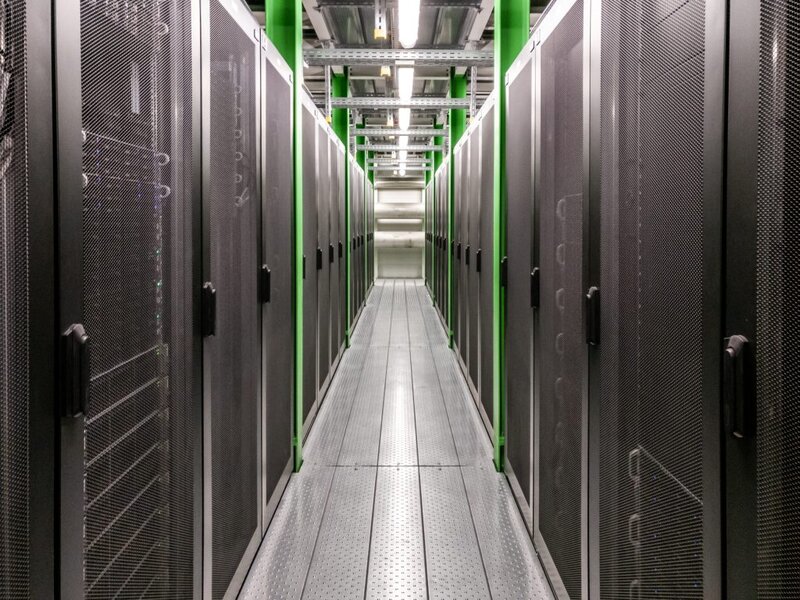
For IT managers and infrastructure engineers in the health and finance sectors, the term “downtime” carries a weight far heavier than a mere inconvenience. In a hospital, it can delay patient care. In a pharmaceutical lab, it can compromise irreplaceable research data. For a financial institution, it means transactions halt and customer trust evaporates. In these fields, the goal isn’t just minimal downtime; it’s zero downtime.
Achieving this benchmark isn’t a matter of chance; it’s a result of meticulous engineering and strategic design. A zero-downtime data centre is like a highly specialised living organism, with interconnected systems working in perfect harmony to ensure continuous operation. Understanding its anatomy is the first step towards building a truly resilient and compliant digital fortress.
As an APC Elite Partner and a national provider of physical IT infrastructure, Powerfirm specialises in architecting these critical environments. Let’s dissect the essential components that form the anatomy of a data centre built for the uncompromising demands of the health and finance industries.
1. The Heartbeat: Uninterruptible & Clean Power Delivery
The most fundamental element of any data centre is its power. However, for sensitive medical equipment, high-frequency trading servers, and complex lab instruments, it’s not enough to simply have power; it must be constant, clean, and conditioned.
- Uninterruptible Power Supply (UPS): This is the non-negotiable heart of the system. We’re not talking about a basic office UPS. These environments demand an Online Double-Conversion UPS. This technology continuously regenerates a clean sine wave of electricity, completely isolating your critical equipment from power sags, surges, brownouts, and frequency variations that are common on the grid. It ensures the power reaching your servers is perfect, protecting sensitive electronics from damage and data corruption.
- Redundancy (N+1, 2N): A single UPS is a single point of failure. A zero-downtime strategy employs redundancy. An N+1 configuration means there is at least one extra module ready to take over if another fails. A 2N configuration provides a fully mirrored, independent power chain, offering the highest level of fault tolerance.
- Power Distribution Units (PDUs): Intelligent and rack-mounted PDUs are crucial for managing and monitoring power at the individual device level. They allow for remote rebooting of servers and provide real-time data on power consumption, which is essential for capacity planning and preventing overloaded circuits.
2. The Lungs: Precision Cooling & Environmental Control
While power is the heart, the cooling system acts as the lungs, constantly circulating conditioned air to dissipate the immense heat generated by high-density server racks. Standard “comfort” air conditioning is dangerously inadequate for this task.
- Precision Cooling Systems: Unlike office air conditioners that simply lower temperature, precision cooling systems manage both temperature and humidity with extreme accuracy. High humidity can lead to condensation and short circuits, while low humidity increases the risk of electrostatic discharge—both are catastrophic for IT hardware.
- Hot/Cold Aisle Containment: This is a core design principle for efficiency and effectiveness. By physically separating the cold air intake (cold aisle) from the hot air exhaust (hot aisle), you prevent the mixing of hot and cold air. This allows the cooling units to run more efficiently, reduces energy costs, and eliminates “hot spots” that can cause random server failures.
- In-Rack and Liquid Cooling: For extremely high-density racks, such as those used for AI-driven medical imaging analysis or algorithmic trading, direct in-rack or liquid cooling solutions may be necessary. These systems bring the cooling much closer to the source of the heat, providing the most effective method of heat removal.
3. The Nervous System: Intelligent Monitoring & Management
You cannot manage what you do not measure. A zero-downtime data centre requires a sophisticated nervous system that provides constant feedback and allows for proactive intervention before a minor issue becomes a critical failure.
- Data Centre Infrastructure Management (DCIM): This software provides a holistic view of the entire data centre ecosystem. It monitors power usage, temperature, humidity, and the status of UPS and cooling systems from a single dashboard.
- Environmental Sensors: Strategically placed sensors within racks monitor for temperature fluctuations, humidity changes, water leaks, and even smoke. An alert triggered by a water leak sensor from a failing overhead pipe can save millions of dollars in hardware.
- Lifecycle Services & Proactive Maintenance: This is perhaps the most critical management component. Hardware doesn’t last forever. Powerfirm’s Lifecycle Services ensure that every piece of equipment, especially UPS batteries and cooling unit components, is on a proactive maintenance and replacement schedule. A battery that fails during a power cut is no better than having no battery at all. Regular, expert maintenance is the key to ensuring your infrastructure works when you need it most.
4. The Skeleton: Secure Racks & Physical Infrastructure
The physical housing of your IT equipment—the skeleton—is your first line of defence. It needs to be secure, organised, and scalable to accommodate future growth.
- Secure Server Racks & Enclosures: Racks must be physically robust and lockable to comply with regulations governing access to sensitive patient and financial data. Proper cable management within the rack is also crucial, not just for aesthetics, but for ensuring proper airflow and simplifying maintenance.
- Scalable Design: The volume of data in health and finance is growing exponentially. The data centre designed today must be able to accommodate the demands of tomorrow. A modular design approach for power and cooling allows you to scale your infrastructure incrementally, providing a cost-effective “pay-as-you-go” model.
Frequently Asked Questions (FAQs)
Q: We have a backup generator. Do we still need a UPS? A: Absolutely. A generator takes time to start up and stabilise—anywhere from 30 seconds to several minutes. A UPS provides instantaneous, battery-supplied power to bridge that critical gap, ensuring your systems never experience a moment of power loss. The UPS also conditions the power, protecting equipment from the “dirty” power a generator can initially produce.
Q: What is the single most common cause of unplanned data centre downtime? A: Industry data consistently points to UPS battery failure as the number one cause. This is why a proactive maintenance and replacement plan, like the one offered through Powerfirm’s Lifecycle Services, is not optional—it’s essential for a zero-downtime strategy.
Q: How do we start planning for a more resilient data centre? A: It begins with a professional site assessment and project scoping session. An expert will evaluate your current infrastructure, power quality, cooling capacity, and business requirements to identify vulnerabilities and create a roadmap for improvement.
Q: Can we upgrade our existing data centre to be more resilient, or do we need to build a new one? A: In many cases, significant resilience improvements can be achieved by retrofitting existing facilities. Upgrading to a modular UPS, implementing aisle containment, and integrating a robust monitoring system can dramatically improve your uptime without the need for a complete rebuild.
Build Your Foundation of Certainty
A zero-downtime data centre is the ultimate expression of control and certainty in an uncertain world. For the medical, pharmaceutical, and insurance industries, it is the bedrock of trust, compliance, and operational integrity.
Building this complex anatomy requires a partner with deep expertise and a proven track record. At Powerfirm, we provide the specialised delivery, expert installation, and proactive maintenance needed to construct and manage a truly resilient data centre.
Don’t leave your most critical operations to chance. Let us help you architect an infrastructure that never fails.